


Bohdan Luts Wins the 17th Wieniawski Violin CompetitionBohdan Luts Wins the 17th Henryk Wieniawski International Violin Competition
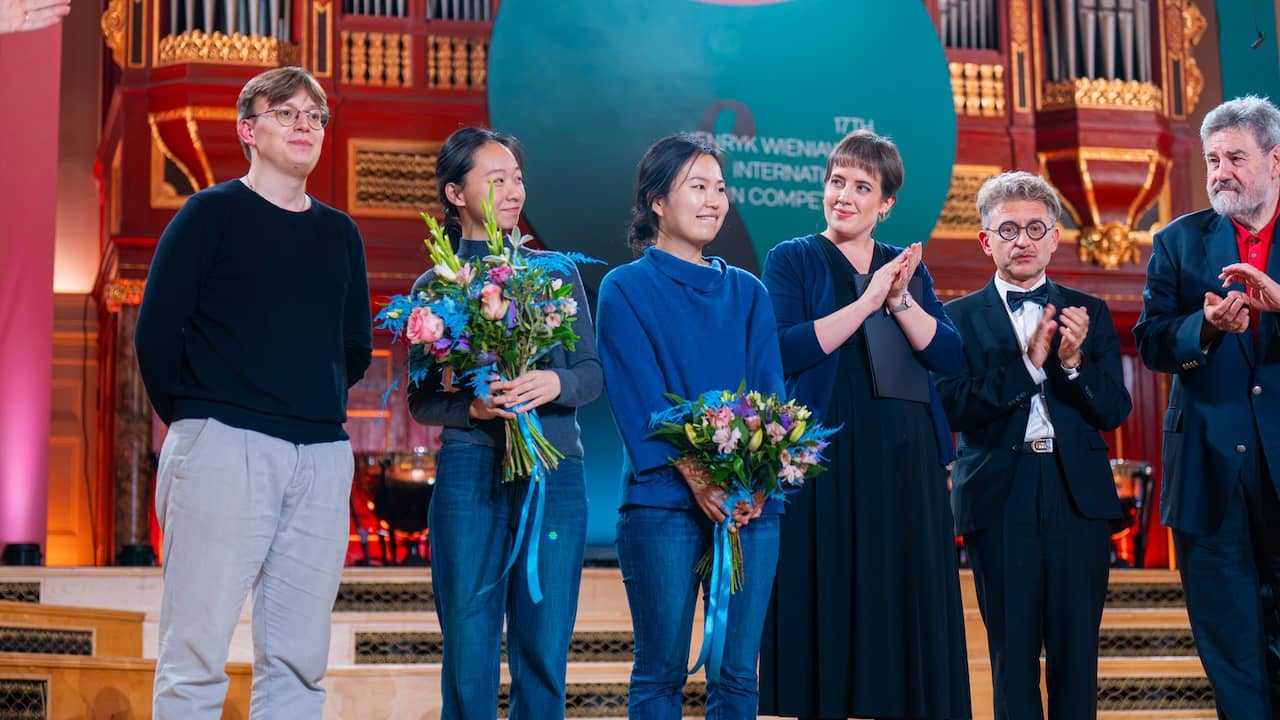
POZNAŃ, Poland – Imagine a sizable metropolis with an airport named after a violinist-composer. To observe that Poznań, home to the world’s oldest violin competition, is proud of its culture is an understatement. Love of music and reverence for the imaginative 19th-century violin virtuoso Henryk Wieniawski dominate the city’s rich cultural life every five years during the competition’s stellar month of musical celebration. On Thursday, Ukrainian violinist Bohdan Luts, 21, was named the first-prize winner of the 17th Henryk Wieniawski International Violin Competition 2026. Nineteen-year-old violinist Jinzhu Li of China won second prize, and SooBeen Lee, 26, of South Korea placed third. It was a week of genuine virtuosity, steeped in a rich history. Below: Bohdan Luts performs Wieniawski’s Violin Concerto No. 2 in D minor, Op. 22, with the Poznań Philharmonic Orchestra conducted by Łukasz Borowicz. First – the history, which is everywhere in Poznań. Born to a family of Jewish heritage near Lublin in 1835, Henryk Wieniawski started his violin studies at the age of five. If historians can be trusted, he never stopped performing from those young years until his untimely death at the age of 44. Another great Polish violinist, the 20th-century legend Szymon Goldberg, once observed: “It was as if Wieniawski bore the mantle of Paganini; after all, he started the violin the year Paganini died. Like that great Italian, Wieniawski was an indefatigable performer whose compositions bear the mark of a virtuoso, written at top speed yet imbued with the greatest love of folk culture, melancholy and gentility.” One hundred years after Wieniawski’s birth, the first Henryk Wieniawski International Violin Competition (HWIVC) in 1935 announced a stellar lineup of prizewinners, including the fifteen-year-old first-prize winner Ginette Neveu, second-prize winner David Oistrakh, Henri Temianka, Boris Goldstein, the child prodigy Ida Haendel and Bronisław Gimpel. Bygone glory aside, if you think that the HWIVC has rested on its laurels, think again. This year’s 17th edition deserves praise for its innovations, not only in terms of jury composition but also for its groundbreaking approach to repertoire. Even in the third decade of the millennium, most international music contests are adjudicated by a roster of established pedagogues, with a smattering of soloists added for the concerto rounds. Refreshingly, the 2026 HWIVC jury was quite different. Jury Chair Bartłomiej Nizioł, first-prize winner of the HWIVC in 1991, was joined by Andrea Obiso, Liviu Prunaru, Gerhard Schulz, Alexander Sitkovetsky, Akiko Suwanai, Agata Szymczewska, Vera Tsu Weiling, Sungsic Yang and Nancy Zhou: eminent performers, top prizewinners, chamber-music legends and famed concertmasters, to mention but a few of the jury members’ accomplishments. Radical changes with regard to repertoire became the talk of the town. The new-style HWIVC offers an encounter with young artistic personalities, with music expressed as a common language across borders. The contest’s director, Karolina Kaźmierczak, emphasized: “We are a small team who reached out to many advisors and held countless meetings to discuss the finer points of the repertoire, in the hope of keeping the spirit of Wieniawski alive by putting Polish composers in the limelight and allowing contestants to show many sides of their personalities.” Jury member Akiko Suwanai, who won top prizes at both the Queen Elisabeth and Tchaikovsky competitions, concurred with the innovation: “At this contest you have to create your own scenario, make a program that will define your communicative skills.” Anna Im, a 2026 laureate and prizewinner at an impressive array of competitions, reacted positively to her repertoire adventure: “It allowed us to become acquainted with many interesting pieces we would never have known before. It gave us a different challenge from other competitions.” Following the preliminary round, the second round called for a recital designed to stimulate dialogue between Polish and other compositions. Contestants could choose between two options: to present a sonata from the renowned canon (e.g., Ravel, Grieg, Schumann or Fauré) alongside works by Polish composers (Szymanowski, Lutosławski or Weinberg), or to feature Polish sonatas (Bacewicz, Paderewski, Szymanowski or Penderecki) as the centerpiece of their program, combined with virtuosic compositions by the likes of Saint-Saëns, Waxman or Ysaÿe, to test their judgment and versatility. The third round called for a performance of one of the following works, all four far beyond the spectrum of other contests: Górecki’s Concerto-Notturno, Op. 13; Andrzej Panufnik’s Violin Concerto; Pēteris Vasks’s Vox Amoris, Fantasy for Violin and Strings; or Mieczysław Weinberg’s Concertino, Op. 42. Jury member Liviu Prunaru observed: “A challenging choice that, in my mind, led to some perhaps problematic decisions. The Panufnik, for example, called for a great deal of study and analysis, while the Weinberg, a truly beautiful composition, is much easier to learn and disseminate. It is not easy to adjudicate if we compare a complicated score to an easy-listening piece.”
Similar quandaries arose with the concerto choices in the fourth round. The selection of concertos at Stage 4 included the warhorses – Brahms, Beethoven, Sibelius – with the addition of the Dvořák Concerto, the comparatively unknown Karłowicz Violin Concerto and, surprisingly to those of us who are veteran competition reporters, the Mendelssohn Violin Concerto. Sibelius and Brahms were selected by the majority of semifinalists, with only one opting for a different choice, the Dvořák Concerto. The first evening of semifinal performances featured six young artists. Meng Zou (24), a Chinese violinist studying in Singapore, opened the evening with the ever-popular Sibelius Violin Concerto. Perhaps competition fatigue and/or a lack of orchestral performance experience took its toll. Blessed with a high-intensity vibrato and a large tone, his approach to the score was pedantic in comparison to other contestants. Korean violinist Jooha Choi (24) opted for the Brahms Concerto, a wonderful vehicle for her rapturous, large sound. Her focus was on projection and stability, yet for all her admirable violinistic skills, a convincing personal interpretation did not reveal itself. The most experienced among the first night’s performers, Anna Im (Korea, 27), set a high bar for her musical goals. A highly charged Brahms introduction contrasted with the tranquility of her slow movement, replete with tonal color and inner calm. The final night of the concerto semifinals opened with a magical performance of the Sibelius Concerto given by another experienced performer, the Korean violinist SooBeen Lee (26). And what a performance it was! Below: SooBeen Lee performs Sibelius’s Violin Concerto in D minor, Op. 47. From her otherworldly, atmospheric opening to the ferocious power of the first-movement cadenzas, this was a performance that took the audience on a musical voyage to the depths of the composer’s soul. Able to coax dialogue from the orchestral wind solos, Lee treated the audience to a dance party punctuated with atavistic rhythms in a passionate closing movement. The nineteen-year-old Chinese violinist Jinzhu Li is a phenomenon of energy and temperament, blessed with a powerful left-hand technique. Spinning a rich sound while executing pyrotechnics to perfection, her Sibelius was dramatic and virtuosic, albeit less original than that of the previous finalist. Bohdan Luts (Ukraine, 21) closed the concerto round with an exquisitely wrought Dvořák Concerto. Showing musical maturity far beyond his 21 years, he drew the audience into a deeply poignant listening experience. Pianissimo cantilena second themes contrasted with his dynamic understanding of the folk elements that abound in this often-overlooked concerto. Below: Bohdan Luts performs Dvořák’s Violin Concerto in A minor, Op. 53. It is only fitting that the six competitive rounds at this year’s HWIVC ended with Wieniawski concertos. The decision to opt for the first or the second concerto is fraught with dilemmas. The notoriously challenging F-sharp minor concerto, penned by the composer at the age of 17, stands in contrast to the melodious second concerto, often considered to be a student’s steppingstone to the major concertos. Listening to Michael Rabin’s and Itzhak Perlman’s iconic renditions of the F-sharp minor concerto obliterates that “technique over merit” stereotype, and no listener will ever look down on the Second Concerto after taking a trip down memory lane to hear Shlomo Mintz’s or Pinchas Zukerman’s exemplary recordings. SooBeen Lee and Jinzhu Li both chose the First Wieniawski Concerto, while Luts ended the competitive rounds with the Second. Both Lee and Luts are competition veterans who have secured major prizes, but it was the newcomer Jinzhu Li who won the audience over with her palpable onstage joy and her powerhouse performance of the devilish No. 1. Below: Jinzhu Li performs Wieniawski’s Violin Concerto No. 1 in F-sharp minor, Op. 14. Bohdan Luts took a serene approach to the soundscapes of the Second Concerto, and Lee showed her prodigious technical mettle in her performance of the F-sharp minor concerto. While the audience favored Jinzhu Li, it was Bohdan Luts who received the coveted first prize, together with a two-year loan of a 1711 Stradivarius violin.
During the award ceremony preceding the first of several gala concerts, Jinzhu Li received the majority of the special awards, and SooBeen Lee won a well-deserved prize for the best performance of a Wieniawski Caprice in an earlier round. At every competition there are young artists who do not make it to the final rounds. To dispel any doubts among disgruntled listeners, the HWIVC 2026 will publish the jury rankings – yet another welcome innovation to add to its list of accomplishments. One of three contestants who were favored by many audience members and critics but did not advance to the final stage, Teofil Milenkovic, received a prize for the best interpretation of a Polish concerto. Two Chinese participants, Zhixin Zang and Jiachen Cao, and the highest-ranked Polish contestant, Zofia Anna Olesik, were also praised in fervent discussions among Poznań’s many music aficionados. In retrospect, the encouraging words of jury president Bartłomiej Nizioł ring true when considering the great performances that took place in Poznań. Emphasizing that music can bring great harmony and build bridges across all borders, he stressed the true worth of a musical journey over the momentary glory of prizes: “There are no losers at this competition. All of these young musicians are winners, true musical heroes.” A parallel can be drawn when perusing reviews of Wieniawski’s many concerts. Writing about a performance at Leipzig’s Gewandhaus in the 1850s, one critic observed: “His playing is a testament to a genuine, rather than superficial, talent.” Exuberance, depth, poetic sensitivity and flamboyant virtuosity – Wieniawski is surely smiling in acknowledgment of the prizewinners of the 17th HWIVC. Translation: Meistervioline © Copyright by Violinist.com. First published at: https://www.violinist.com/blog/hkurzbauer/202610/30898/ Keep exploring
From our shop Premium violin cases and top-tier string sets — for competition and the stage. |
LoginFeatured - [more]Specials - [more] GEWA Air 2.1 oblong violin Case B-WARE - BROWN 789.00 € 539.00 € |

 by Heather Kurzbauer · October 23, 2026







| Contact Information | Meistervioline Quick Links | Articles & Interviews | Meistervioline Customer Service |
|
Meistervioline.com Felipe Manrique Richtstrecke 10 A 45731 Waltrop Germany Phone: +49 (0)2309 551355 Fax: +49 (0)2309 782173 Email: info@meistervioline.com |

|
Copyright © 2006-2026 Meistervioline.com - Online store for string instruments & accessories Trusted Shops certified since 2017Shopsystem: Zen Cart